Noah
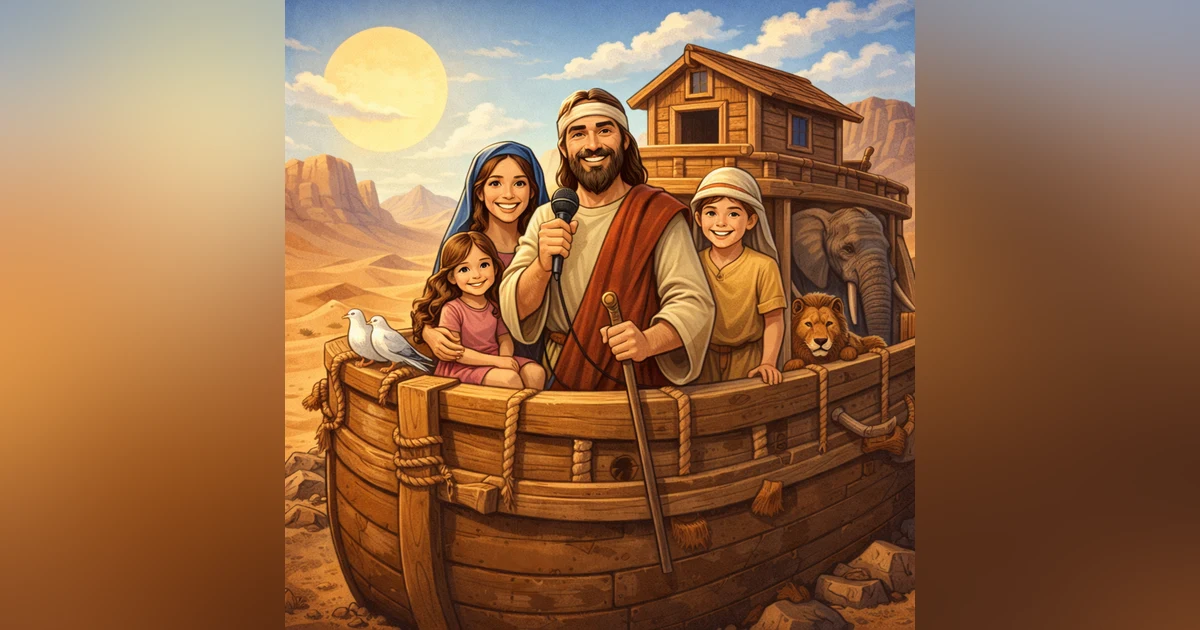


In our personality profile series we look at Paper 78 and the story of Noah. Was the story of the flood real?
The story of Noah serves as a good example of our stories become legend, and eventually sacred. Many biblical stories started out this way, and Paper 78 explains why so much of Jewish history became sacred over time.
0:29 The well, I'm excited because I get to spend the next 30 minutes talking about the Urantia book and some of the exciting things that are going on. I want to offer up some producer notes before we get going. The time I spent with Byron Belitsus was excellent. I hope you will take a listen. That's the preceding podcast and it was good to have him in it it. It sparked a lot of response. We had some great response from listeners, including one that I wanted to share with you because I thought it was just so well written. You know, the issue of how we brand and the Urantia movement. What's next? What do we do? You know, how are we to deal with the future? How do we make this thing grow?
1:13 Because we believe that the Urantia book offers some real assistance to at least culture and humanity and certainly spiritual progress. And so I got a an e-mail and I got permission to share it. Normally I wouldn't share it unless I get permission. So you can always e-mail me and I'll never share it unless you give me permission. But this one comes from Michael. Michael writes after listening to the previous episode with my guest, Byron. He says the main issue with the Ranch book, as I see it, is that it's intimidating by both its size and by the amount of information that it contains. So I propose that the Oranga Foundation produce a series of booklets for public distribution. Examples would be what the Oranga book teaches about physics.
2:05 This would also include topics such as the Ultimaton, which would interest particle physicists and could be handed out at national, international meetings of physicists. I think that's a really good idea for so many different reasons, because in, in Michael's right, the, the size of the book is very intimidating. And then when you start to look at the table of contents, that can can also be a bit overwhelming. But what if you were able to take the elements of the Urantia book and, and sort of order it by section or topic? And then you could have what the Urantia book teaches about physics, what the Urantia book teaches about all kinds of different cosmology about Jesus. It, it kind of reminds me of the, if any of you are familiar with Khalil Gibran and he came out with a book, he's a Lebanese philosopher guru from the early 1900s. And he wrote a book called The Prophet. And I always made it a habit of giving that book the Prophet. It's, it's only about maybe 120 pages. And anytime I was invited to a wedding, I think I must have handed that book out to, you know, a few people that I knew that got married.
3:23 I said, this is a good book for your family. And why did I do that? Why not? Why not hand him the Urantia book? Well, the The Prophet is such a well written book. And it's this man's opinion on how he feels about love, about death. It's easy to read. It's very comforting, very deep, and for the most part pretty consistent with the teachings of most great religions, including the Urantia book. So I think Michael has a good point. It we have this book, it's, it's obviously complex. It's, it's written with the intent of being around for a while. I think it's, this book will be studied for centuries perhaps.
4:03 But wouldn't it be great to have a sort of a condensed by topic, maybe a, a box set, you know, maybe pick the 10 things that most people would be interested in. And, and to that end, I started working on a sort of an instruction chart. If I were, if I were to teach the Urantia book, I would need a syllabus. So I'm creating a syllabus kind of based on what, what Michael is talking about. And I think he's right. These little booklets would be helpful to helping people who really probably have a great curiosity about the Urantia book. And, and I, I think it's a good idea, you know, because I think the, the walk away message I got from Byron, which I really appreciate it is he says we have to identify who our target audience is.
5:02 And believe me, when, when I do these episodes, I also think about, you know, who am I talking to? It's one person and it's, it's a, it's a kind of person that might be interested in religion to begin with. Maybe that person isn't necessarily religious in the way that many of us think of people that are religious who go to church, get involved in all those kinds of things. But I have to be honest, I, I don't think of myself as a, a proselytizer. My, my approach to the Urantia book is based on the acceptance of, of this being the narrative of reality. So I accept my cosmic citizenship. I act as if I am part of an eternal universe and that this is my job.
5:55 This is, this is my position right now at this juncture of my life getting started. And to me it, it's, it's like I am a, I'm a Roman citizen. And, and now that I know that there is this grand and I'm use that as a metaphor that, that, that I've been informed that this is a grand universe of lots of things going on, then I, I want to be a part of that because what I do here actually contributes to that overall mission, doesn't it? I think it does could have a section where we talk about what these the Urantia book teach about Jesus or what does it teach about the afterlife.
6:37 And there's all these different things that we could not so much take the place of the Urantia book, but is one of my favorite expressions to provide A to remove the barriers of entry, you know, to provide safe harbor, to let people feel comfortable, you know, put it on and what does it look like? How does it feel? And then if it, if it rings true, if you read, for example, the section on marriage and what it teaches about family life and the importance and the contribution, you might find yourself saying, you know what, I agree with that too. Maybe you want to know what does it talk about when it talks about angels?
7:24 You know, I think I kind of believe in angels. I think a lot of people, in fact, I think more people believe in angels than probably believe in Christ himself because there's something appealing about it, right? So I, I guess the point is, is that our audience is really twofold people who want an updated, maybe gospel, an updated presentation of what the gospel really is. What was Jesus really trying to teach and, and not just the religion about him that we find in the in the Bible, but the but the story of his life and how he lived his life and, and what he was attempting to do with his Incarnate bestowal.
8:12 You know, people think that Jesus was when he was a little kid knew that he was the Son of God. And that's not true. He lived a life just like every other human being. But that self-awareness came in part because his was a spiritual mission, and as he grew in spiritual wisdom and life experience, it was like 2, two things coming together and then one course, the day of baptism, when the voice came speaking from the sky, that is when we're told that Jesus had final confirmation on his relationship with the Father and who he was and his mission.
8:57 Now, you may not get that that story from the Bible. I've read the Gospels, I've read Matthew, Mark, John, I've read Luke. I've read many of the books of Paul. And I can tell you that the only time I've ever felt like I truly understand what the mission of Jesus was, was when I read the Urantia book. Now there are other topics that are more complicated, like physics and things like that. So I'm just putting it out there that, you know, each of us could benefit if, if we're interested in sharing the book with people that maybe the approach is to #1 figure out who it is you think you're, you're appealing to, not the world like Byron said. And then the other element of that is some people just want to know about the book.
9:52 Some people want about the, about the gospel. Some people want to know about what's what's in the book and what the book tells us about and and I learn more toward that as well. I find many of these podcasts are about explaining some of the more exciting concepts of the book. For example, we have started our new sort of miniseries on personalities of the Urantia book. And so far I think we talked about in the last episode was Grand Fonda. That was my choice. I had another listener say they wanted to hear more about Melchizedek, so I think I will do that. I did spend an episode or two on Macha Venta, but it's worth revisiting again because he's such an important part of our history.
10:42 And it's really a shame that the Bible doesn't give him more shell space because Macha Venta, the Sage of Salem was really the third revelation of epical proportions. So he's, he was not the the Jesus revelation, but before him setting, setting the way for the 4th epical revelation. So he's worth another visit. I got a great request from someone who wanted to talk about Noah. So I want to get into Noah for two reasons. One, because Noah's a fascinating individual on the pages of history, and two, it also helps me talk about why the Urantia book is is important as a text because it fills in a lot of missing pieces of our history.
11:43 But more than that, it also sobers us up to the difference between what is known as sacred history and profane history. Many of our problems of society today, particularly with the the constant battle going on in the Middle East, is a result of that sacred history. So let's talk about Noah. But before we we do that, let's jump into page 78 and it talks about the state of the Jewish people and it talks about the early books of the of Scripture, the Old Testament, the Torah and, you know, parts of the Hebrew Scripture.
12:32 So from paper 78, we pick up with with this entrance into the story. And then we'll get into Noah a little bit. The book writes that almost 5000 years later, as the Hebrew priests in Babylonian captivity sought to trace the Jewish people back to Adam, they found great difficulty in piercing the story together. And it occurred to one of them to abandon the effort to let the whole world drown in its wickedness at the time of Noah's flood, and thus to be in a better position to trace Abraham right back to one of the three surviving sons of Noah. Continuing on, the traditions of a time when water covered the whole of the Earth's surface are universal.
13:19 Many races harbor the story of a worldwide flood sometime during past ages. The biblical story of Noah, the Ark, and the flood is an invention of the Hebrew priesthood during the Babylonian captivity. There has never been a universal flood since life was established on Urantia. The only time the surface of the earth was completely covered by water was during the Rkozoic ages, before the land had begun to appear. That's a very important statement that the Urantia book is stating, which is that the entire story of Noah, the flood, the 40 days and 40 nights. And there are elements of the story that are true, but as far as it being because God wanted to destroy the wicked of earth, this is actually contesting that story. It's saying that's not true.
14:26 And the person who told me about Noah came up with the idea of doing a little bit on Noah said to me, you know, that changed my life. Learning that truth changed my life because I always thought, why would a loving God destroy humanity? And think of how much that idea is rooted particularly in evangelical circles. It is under that that same feeling, that same thought process of of having national or ethnic guilt, believing that your race or your tribe is suffering because God is angry at you. In many ways and in many respects, the Arantia book informs us that we have to move away from that thinking. It's it's not any different from if you had an earth father who was abusive, if you thought that your earth father was going to whip you because you were evil.
15:32 That's what you're likening God to be like, that he is punishing us because we're evil and because Eve created the first sin and we had that sinful nature. And the Hebrew condition arose because for hundreds and hundreds, 800 years, they were under the captivity of the Babylonians. I mean, they, they essentially, they went from being, you know, Bedouins to Egyptian slaves. And then they started to sort of form their own little nation, promoting monotheism in the teachings of Abraham. And they suffered for it. But that sort of explains why in the Bible and in the Old Testament, we have the story of the universal flood of of being punished.
16:28 And because it's rooted in this, this sense of racial guilt. Now Paper 78 goes on and says, but Noah really lived. He was a wine maker of Arum, a river settlement near Eric or Iraq. He kept a written record of the days of the river's rise from year to year. He brought much ridicule upon himself by going up and down the River Valley, advocating that all houses be built of wood boat fashion, and that the family animals might be put up on board each night as the flood season approached. He would go to the neighboring river settlements every year and warn them that in so many days the floods would come.
17:12 Finally, a year came in which the annual floods were greatly augmented by unusually heavy rainfall. So that was the sudden rise of the waters that wiped out the entire village. Only Noah and his immediate family were saved in their houseboat. So there's the story. It's a short story, really. It's interesting that the revelators knew about him and knew about the fact that the story in the Bible comes from this man. And I'm, I'm putting the age at around maybe 6-7 thousand years ago, probably about 5000 BC.
17:55 I'm guessing that's probably, you know, geologists could probably make that determination if and also that area, which is basically Syria moving eastward towards Iraq or what was Babylonia, That whole area is, is always subjected to those kinds of flooding. It's, it's very flat. And if you, if you looked at any geography, you can see that there's been plenty of water flow from floods. They sort of dredge out into the Gulf if you're looking at it from like a bird's eye view. But I, I just want to ask you before we conclude, how does this idea sit with you?
18:35 Does it make you feel less close to God? Or does it challenge the authority of the Bible to, to think of the fact that the whole story of the universal flood, which is so much a fabric of, of our religion. If you're born Christian or raised in a Christian environment, I think I felt like relieved, like Janie, I felt like, you know what that story And really I think I like the story better. It's it's more grounded in reality really here, let me continue reading. It says 500 years of overlordship of alien rulers was too much for even the patient and long-suffering Jews.
19:17 This is you be talking about the difference between sacred history and profane history. The prophets and priests began to cry. How long, O Lord, how long as? As the honest Jews searched the Scriptures, his confusion became worse confounded. An old and seer promised that God would protect and deliver His chosen people. All modern religions have seriously blundered in the attempt to put a miraculous interpretation on certain epochs or epochs of human history. While it is true that God has many times thrust a Father's hand of providential intervention into the streams of human affairs, it is a mistake to regard theologic dogmas and religious superstition as a supernatural sedimentation appearing by miraculous action in this stream of human history. The fact that the Most Highs rule in the kingdoms of men does not convert secular history into so-called sacred history. So much of our belief and faith and honor really honor. Is aimed more at the prophets in the fact that they carried the truth of monotheism forward.
20:35 You know they deserve great respect and honor to be sure. But in that emotion came the the sacred element of of turning these stories, many of them, into supernatural events. Noah is a good example of history being made sacred. There was the event Noah did exist, he warned his followers about rising waters and they ignored him. But the story then gets expanded to include the destruction of humanity, God's earth destroyed because of wickedness. The essence of this seems to portray that stories of the miraculous should not be the pretext for believing in God, especially the kind of creator who may harm his kids in Mass because they have become spoiled little brats and nothing more than petulant and spoiled children and whom refused to clean up their mess. As I conclude, and I think we all know who we're talking about.
21:33 So your personality profile suggestion? e-mail me at urantiabookradio@gmail.com. Also, let me know if you like some of the edition of some of the jazz music I've been throwing in. I'm a big, I'm a fond, the lover of jazz music, and I think it adds a little spark. Let me know what you think. We'll be back soon. Another edition of the Your Rancho Radio podcast, soon to come. Be well and be a good cheer. Music.