Matthew and Thomas
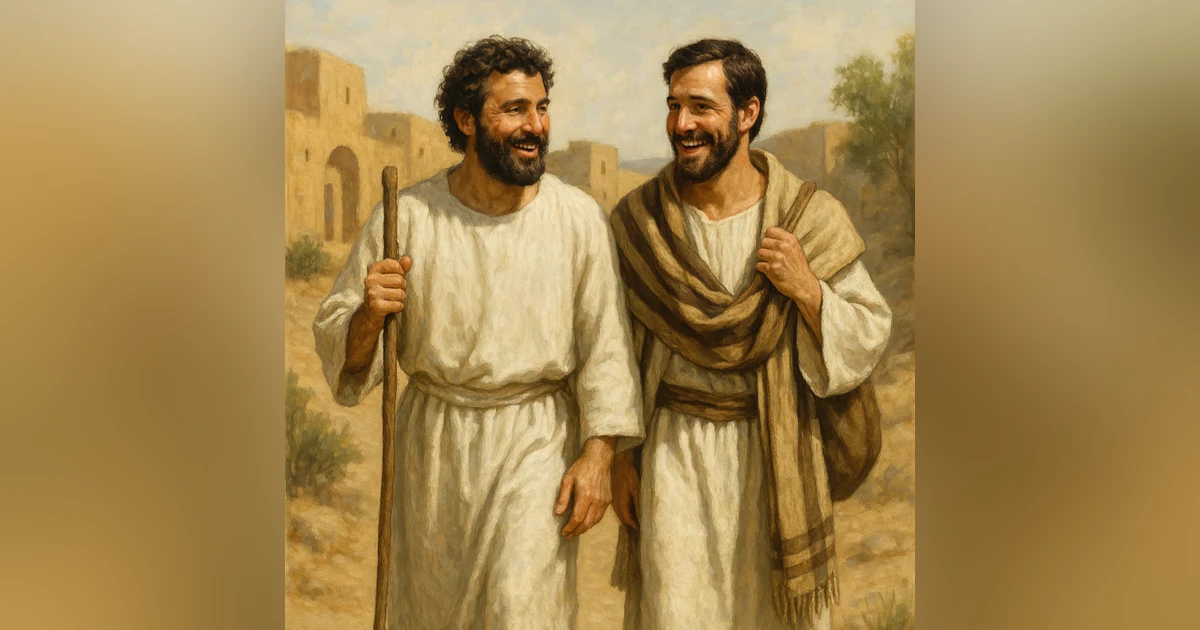


We continue with our series on several of the more notable Apostles, as described in paper 139 of the Urantia Book.
We learn about the diverse backgrounda and personality of Matthew Levi, and his fellow Apostle Thomas Dydimus; what made these men tick, what was their family life like, and how did Jesus appeal to them?
Many readers relate to one or more of the Apostles, perhaps there are qualities in these two men that will touch your heart.
0:00 Well, it's another day at Urantia Radio, and I sure am glad that you decided to check it out. And as you know, in the preceding episodes, we've been taking a look at the Apostles 2 by 2. I don't know if we'll go through all of them. I'm wanting more just to convey the message that for a lot of people who were introduced to the Urantia book, a really good place to start, especially if you have any kind of Christian upbringing, are the papers depicting the 12 apostles. And that would be in Part 4, paper 139. And it is a great read and it's inspiring and you learn a lot and you walk around in your head thinking about these guys and then what their relationship was with Jesus as he walked the earth. And the character descriptions of each of these apostles is very much in depth.
0:47 And, and it's it's, it's a great read. It's just an inspiring read. So we're going to continue with Matthew and Thomas in this edition. And then also I want to share a very interesting and ennobling letter that was submitted to the Mini Messenger. If you subscribe to the Mini Messenger over at the association, I think it is and I want to share with you and it has to do with Marancha Mota and just an interesting take by the author. So we'll get to that, all of that coming up. And then also the Urantia Book School is just around the corner. So once again, it is time to go back to school. And of course, the Ranchi Foundation offers free online courses from UBIS and it starts on April 21st to kind of an appropriate day, huh? That's when they start registering. So you can go online and you can register for class and you have all these different courses that you could take. And other people from around the world are also participating. And it's a reading and it's a writing exercise. And they have a moderator who guides everyone along. And it's a very nice, nice thing to do for yourself. And again, it's, it's, it's a way of studying the book in a social setting and at a very good pace, which is very important because we're all very busy in these days. And again, registration opens after Monday, April 21st. And then of course, the scientific symposium, there's only a few more days left.
2:14 I think Tuesday is the cutoff if you want to make a presentation. And the symposium is going to be in Chicago. And they do this annually and that'll be on November 6th. And those are the two big events coming up in the Urancha world. So let's get to Matthew Levi and Thomas in just a second here. We'll take a quick break for the sponsors and then we'll be talking about the apostles and, and their story. Matthew Levi. It's funny, we have a, a shelter in town and they, they get a lot of publicity because they do a lot to feed the children and clothe young people, people that are in poverty, impoverished families. And I, and after reading Matthew Levi recently and I made the connection of how house it's a place of charity.
3:02 And when you read about Matthew, you'll better understand that. So we'll take a quick break and continue on the Rancho Radio podcast. Matthew, the 7th apostle was chosen by Andrew. Matthew belonged to a family of tax gatherers or Republicans, but was himself a customs collector in Capernaum, where he lived. He was 31 years old and married and had four children. He was a man of moderate wealth, the only one of any means belonging to the Apostolic Core. He was a good businessman, a good social mixer, and was gifted with the ability to make friends and to get along smoothly with a great variety of people. Andrew appointed Matthew the financial representative of the Apostles.
4:01 In a way, he was the fiscal agent and publicity spokesman for the Apostolic organization. He was a keen judge of human nature and a very efficient propagandist. His is a personality difficult to visualize, but he was a very earnest disciple and an increasing believer in the mission of Jesus and in the certainty of the Kingdom. Jesus never gave Levi a nickname, but his fellow apostles commonly referred to him as the money getter. Levi's strong point was his wholehearted devotion to the cause. That he, a publican, had been taken in by Jesus and his apostles was a cause for overwhelming gratitude on the part of the former revenue director. However, it required some little time for the rest of the apostles, especially Simon Zealots and Judas Iscariot, to become reconciled to the publicans presence in their midst.
4:59 Matthew's weakness was his short sighted and materialistic viewpoint of life, but in all of these matters he made great progress. As the months went by. He of course had to be absent from many of the most precious seasons of instruction as it was his duty to keep the treasury replenished. It was the masters forgiving disposition which Matthew most appreciated. He would never cease to recount that faith only was necessary for the business of finding God. He always liked to speak of the Kingdom as this business of finding God. Though Matthew was a man with a past, he gave an excellent account of himself, and as time went on, his associates became proud of the publican's performances.
5:44 He was one of the apostles who made extensive notes on the sayings of Jesus, and these notes were used as the basis of Izidor's subsequent narrative of the sayings and doings of Jesus, which has become known as the Gospel according to Matthew. The great and useful life of Matthew, the businessman and customs collector of Capernaum, had been the means of leading thousands upon other businessmen, public officials and politicians down through the subsequent ages. Also to heed the engaging voice of the Master saying, Follow me. Matthew really was a shrewd politician, but he was intensely loyal to Jesus and supremely devoted to the task of seeing that the messages of the coming Kingdom were adequately financed. The presence of Matthew among the 12 was the means of keeping the doors of the Kingdom wide open to hosts of downhearted and outcast souls who had regarded themselves as long since without the bounds of religious consolation. Outcast and despairing men and women flock to hear Jesus, and he never turned 1 away.
6:58 You know, there is sort of A and especially in today's modern world, many people that are part of the world of industry and they're busy and they're working their, you know, tails off to make ends meet and succeed. And sometimes when you are so focused on that you forget about, you know, the, the spiritual aspects and the, and the long term meaning of what you do and what you achieve. And I think in drawing this Matthew, he drew one from that kind of mindset. People who are just always obsessed with working and making, making it go. And I, I think, you know, tradesmen, financiers, bankers, people in high real estate and, and here is a case where one of them was attracted to the teachings of Jesus. And, and, and Matthew's legacy is that he sort of made that an agreeable thing for people to be religious and be successful at the same time in their material life. And that's what Matthew has brought to the table. Continuing on, Matthew received freely tendered offerings from believing disciples and the immediate auditors of the Master's teachings, but he never openly solicited funds from the multitudes.
8:15 He did all of his financial work in a quiet and personal way, and raised most of the money among the more abundant of the more substantial class of interested believers. He gave practically the whole of his modest fortune to the work of the Master and his apostles, but they never knew of his generosity, save Jesus, who knew all about it. Matthew hesitated openly to contribute to the Apostolic fund for fear that Jesus and his associates might regard his money as being tainted. So he gave much in the name of others or other believers. During the earlier months, when Matthew knew his presence among them was more or less a trial, he was strongly tempted to let them know that his funds often supplied them with their daily bread, but he did not yield.
9:07 When evidence of the disdain of the publican would become manifest, Levi would would burn to reveal to them his generosity, but always he managed to keep still. That says a lot about his his self-discipline. He could brag and tell him, well, look, I'm the one that made all of this possible. But he didn't yield to that temptation. That's a man of strong character. When the funds for the week were short of the estimated requirements, Levi would often draw heavily upon his own personal resources. Also, sometimes when he became greatly interested in Jesus's teachings, he preferred to remain and hear the instruction, even though he knew he must personally make up for his failure to solicit the necessary funds.
9:53 But Levi did so wish that Jesus might know that much of the money came from his pocket. He little realized that the Master knew all along about it. The apostles all died without knowing that Matthew was their benefactor, to such an extent that when he went forth to proclaim the Gospel of the Kingdom after the beginning of the persecutions, he was practically penniless. When these persecutions caused the believers to forsake Jerusalem, Matthew journeyed N preaching the Gospel, the Kingdom, and baptizing believers. He was lost to the knowledge of his former Apostolic associations, but on he went, preaching and baptizing through Syria, Cappadocia, Galatia, Bithynia, and Thrace. And it was in Thrace at Lysimachia that certain unbelieving Jews conspired with the Roman soldiers to encompass his death and this regenerated public, and died triumphant in the faith of salvation.
10:57 He had so surely learned from the teachings of the Master during his recent sojourn on earth. Thomas was the 8th apostle, and he was chosen by Philip. In later times he had become known as Doubting Thomas, but his fellow apostles hardly looked upon him as a chronic doubter. True, he was a logical, skeptical kind of mine, but he had a form of courageous loyalty which forbade those who knew him intimately to regard him as a trifling skeptic. When Thomas joined the apostles, he was 29 years old, was married, and had four children.
11:41 Formerly he had been a Carpenter in stonemason, but latterly he had become a fisherman and resided at Terekia, situate on the West Bank of the Jordan, where it flows out to the Sea of Galilee, and he was regarded as the leading citizen of this little village. He had little education, but he possessed a keen reasoning mind, and was the son of excellent parents who lived in Tiberius. Thomas had the one truly analytical mind of the 12. He was the real scientist of the Apostolic group. The early home of life Thomas had been unfortunate. His parents were not altogether happy in their married life, and this was reflected in Thomas's adult experience. He grew up having a very disagreeable and quarrelsome disposition.
12:32 Even his wife was glad to see him join the apostles. She was relieved by the thought that her pessimistic husband would be away from home most of the time. Thomas also had a streak of suspicion which made it very difficult to get along peaceably with him. Peter was very much upset by Thomas at first, complaining to his brother Andrew that Thomas was mean, ugly and always suspicious. But the better his associates knew Thomas, the more they liked him. They found he was superbly honest and unflinchingly loyal. He was perfectly sincere and unquestionably truthful. But he was a natural born fault Finder and had grown up to become a real pessimist. His analytical mind had become cursed with suspicion. He was rapidly losing faith in his fellow mortal men when he became associated with the 12 and thus came in contact with the noble character of Jesus.
13:30 This association with the Master began at once to transform Thomas's whole disposition and to affect great changes in his mental reactions to his fellow men. Thomas's great strength was his superb analytical mind, coupled with his unflinching courage when he had once made-up his mind. His great weakness was his suspicious doubting, which he never fully overcame throughout his whole lifetime in the flesh. In the organization of the 12, Thomas was assigned to arrange and manage the itinerary, and he was an able director of the work and movements of the Apostolic Group. He was a good executive and excellent businessman. He was handicapped by his many moods. He was one man one day and another man the next. He was inclined toward melancholic brooding when he joined the apostles, but contact with Jesus and the apostles largely cured him of this morbid introspection. Jesus enjoyed Thomas very much and had many long personal talks with him.
14:34 His presence among the apostles was a great comfort to all honest doubters and encouraged many troubled minds to come into the Kingdom, even if they could not wholly understand everything about the spiritual and philosophic phases of the teachings of Jesus. Thomas's membership in the 12 was a standing declaration that Jesus loved even honest doubters. The other apostles held Jesus in reverence because of some special and outstanding trait of his replete personality, but Thomas revered his master because of his superbly balanced character. Increasingly Thomas admired and honored one who was so lovingly merciful, yet so inflexibly, just and fair.
15:19 So firm but never obstinate, so calm but never indifferent, so helpful and so sympathetic, but never meddlesome or dictatorial. So strong but at the same time so gentle, so positive, but never rough or rude, so tender but never vacillating. So pure and innocent, but at the same time so virile, aggressive and forceful. So truly courageous, but never rash or foolhardy. Such a lover of nature, but so free from all tendency to Revere nature. So humorous and so playful, but so free from levity and frivolity. It was this matchless symmetry of personality that so charmed Thomas.
16:04 He probably enjoyed the highest intellectual understanding and personality appreciation of Jesus of any of the 12 in the councils of the 12. Thomas was always cautious, advocating a policy of safety first. But if his conservatism was voted down or overruled, he was always the first fearlessly to move out in execution of the program decided upon. Again and again he would stand out against some project as being foolhardy and presumptuous, but he would debate to the bitter end. But when Andrew would put the proposition to a vote, and after the 12 would elect to do that which he had so strenuously opposed, Thomas was the first to say, let's go.
16:49 He was a good loser. He did not hold grudges nor nurse wounded feelings. Time and again did he oppose letting Jesus expose himself to danger. But when the Master would decide to take such risks, always was it Thomas who rallied the apostles with his courageous words. Come on, comrades, let's go and die with him. Thomas was in some respect like Philip. He also wanted to be shown. But his outward expressions of doubt were based on entirely different intellectual operations. Thomas was analytical, not merely skeptical. As far as personal physical, physical courage was concerned, he was one of the bravest among the 12.
17:32 Thomas also had some very bad days. He was blue and downcast at times. The loss of his twin sister when he was nine years old had occasioned him much youthful sorrow and had added to his temperamental problems of later life when Thomas would become despondent. Sometimes it was Nathaniel who helped him to recover, sometimes Peter and not hit, frequently one of the Alpheus twins when he was most depressed. Unfortunately, he always tried to avoid coming in direct contact with Jesus, but the Master knew all about this and had an understanding sympathy for his apostle when he was thus afflicted with depression and harassed by doubts.
18:15 Sometimes Thomas would go get permission from Andrew to go off by himself for a day or two, but he soon learned that such a course was not wise. He early found that it was best when he was downhearted to stick close to his work and to remain near his associates. But no matter what happened in his emotional life, he kept right on being an apostle. When the time actually came to move forward, it was always Thomas who said, let's go. Thomas is the great example of a human being who has doubts, faces them, and wins. He had a great mind. He was no carping critic. He was a logical thinker. He was the acid test of Jesus and his fellow apostles. If Jesus and his work had not been genuine, it could not have held a man like Thomas from the start to the finish. He had a keen and sure sense of fact. At the first appearance of fraud or deception, Thomas would have forsaken them all.
19:15 Scientists may not fully understand all about Jesus and his work on earth, but there lived and worked with the Master and his human associates. A man whose mind was that of a true scientist, Thomas Didymus, and he believed in Jesus Nazareth. Thomas had a trying time during the days of the trial and crucifixion. He was for a season in the depths of despair, but he rallied his courage, stuck to the apostles, and was present with them to welcome Jesus on the Sea of Galilee. For a while he succumbed to his doubting depression, but eventually rallied his faith and courage.
19:58 He gave wise counsel to the apostles after Pentecost, and when persecution scattered, the believers went to Cyprus, Crete, the North African coast and Sicily, preaching the glad tidings of the Kingdom and baptizing believers. And Thomas continued preaching and baptizing until he was apprehended by the agents of the Roman government and was put to death in Malta. Just a few weeks before his death he had begun the writings of the life and teachings of Jesus. And so there you have two stories of two men who had their lives completely changed by their meeting and getting to know the Son of Man.
20:52 And they faithfully served their their role. They took Jesus's words and, and his deeds and what they learned of the man and the relationship that they had. And they went out and spread the gospel of the Kingdom. And it were not for the unseen friends that compose the 4th part of the Urantia book and the Revelation we would never know about these very unique men. I think that's one of the reasons why having known these names all of our lives and have having heard about them or heard them quoted in Scripture. But to actually know, for example, that Thomas had a twin sister, there's nowhere in history where that is stated. But it would explain some of his downcast moods that we do know about. And Matthew having the the bad reputation of being a publican and knowing secretly that he was funding many of the the activities behind the scenes.
21:47 The apostles were not even aware. Taking his own money and making sure to keep the program going for the the public teaching and the preaching of Jesus and these 12 men who dedicated their lives to following this man and teaching his gospel to the rest of the world. So truly a remarkable series and a great example of the the craftsmanship and the literary beauty of the Urantia book and and the Urantia papers. So Speaking of which, we're going to take a quick break and move on to the next episode. And it we're going to explore a wonderful letter that was submitted to the mini messenger that you may get in your inbox from time to time. And this one has to do with Marancha Moda. And if you're not familiar with it, we'll go over it in the next segment.
22:36 So for for now, thank you. And if you've got questions or comments, don't forget you can always reach out to us a couple of different ways. You can e-mail us at your rancherbookradio@gmail.com or you can go online to yourrancherradio.org. And there is actually a comment field and you can either write or you can actually record something if you want to. And I'll be sure to get that message. And again, thank you for joining me on this edition of the Urantia Radio Podcast.